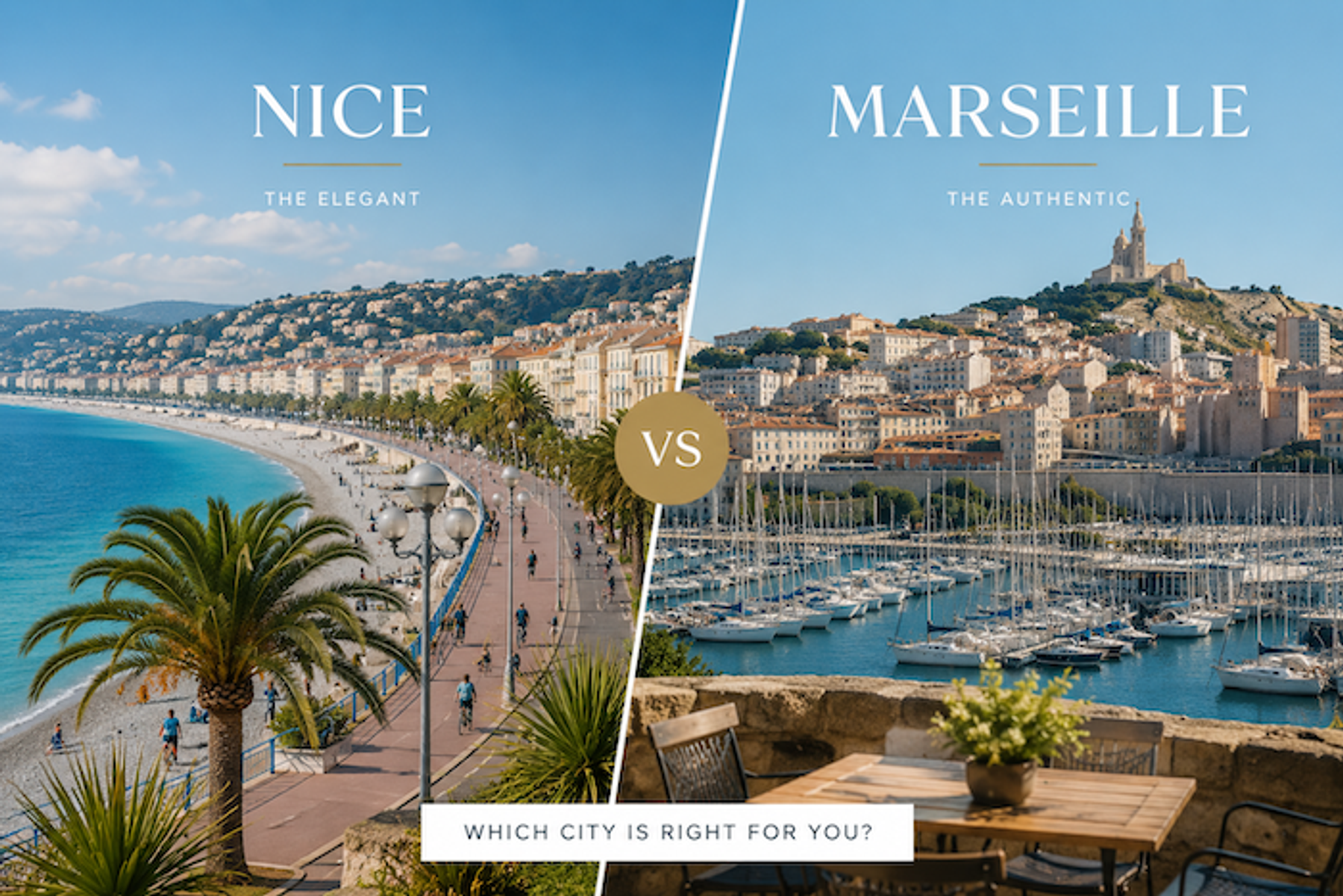
Ask ten people who have lived in the South of France which city they would pick between Nice and Marseille, and you will get ten different answers, often delivered with surprising passion. The two sit less than two hours apart by train, share the same sea and the same sunshine, and yet they feel like they belong to different countries. For international buyers and tenants weighing a move to the Sud, this is one of the most consequential choices you will make. Here is our honest take.
Two very different personalities
Nice is elegant, ordered, and shaped by more than a century as a winter destination for the European leisure class. Belle Époque facades, palm-lined avenues, the Promenade des Anglais curving along the bay. The Old Town, Vieux Nice, is dense with Italianate alleys and the smell of socca (the city's signature chickpea pancake) drifting from corner stalls. There is a clear rhythm to Nice, a sense of a city that knows what it is. Marseille is something else entirely. Founded by Greek sailors around 600 BC, it has spent two and a half millennia as a port and a crossroads. The result is a city that is rough at the edges, unfiltered, intensely creative, and culturally one of the most interesting places in France. The Vieux-Port still functions as a real fishing harbor in the morning. The food, the music, and the neighborhoods all draw on North African, Italian, Armenian, and Provençal influences. A useful shorthand: Nice is a city you live in. Marseille is a city you have a relationship with.
Property prices and what you actually get
This is where the contrast becomes very concrete, and where most generalist comparisons stop short. Both markets reward buyers who understand them at the neighborhood level. Marseille is dramatically more affordable for an equivalent surface, though prices vary enormously by neighborhood. The desirable southern districts (the 7th and 8th arrondissements, around Endoume, Bompard, and Le Roucas Blanc) offer beautiful properties with sea views at prices that simply do not exist in Nice. Local knowledge matters more here than almost anywhere else in France; a street can change character within a few blocks. For a buyer with a budget of 800,000 to 1.2 million euros, the question becomes very different. In Nice, you are competing for a comfortable apartment in a desirable building. In Marseille, you might be looking at a house with a garden and a sea view.
Nice currently averages around 5,200 to 5,300 € per m² across all property types, with apartments at roughly 4,900 to 5,300 € per m² and houses closer to 6,000 to 7,200 € per m². The market is up around 3 to 4 percent year on year, outpacing the national average, after a modest correction in 2023 and 2024. The headline numbers, however, mask enormous variation by neighborhood.
At the top of the market sit Mont Boron and Cap de Nice, the two most coveted residential addresses on the eastern hillside, where prime villas with sea views regularly trade above 10,000 to 15,000 € per m². The Carré d'Or, the prestigious quarter just back from the Promenade des Anglais, holds steady around 7,000 to 8,000 € per m² for Belle Époque and Art Deco apartments in good condition. Cimiez, the genteel residential district above the city favored by families and the historic aristocracy, typically trades between 5,500 and 7,000 € per m² depending on the building and floor. Vieux Nice is more variable, with charming but often poorly insulated apartments ranging from 5,000 to 7,500 € per m² depending on light, floor, and renovation. The Musiciens and Libération areas in central Nice are the sweet spot for many international buyers around 5,000 to 6,000 € per m², while neighborhoods like Riquier and the northern districts remain notably more accessible at 3,500 to 4,500 € per m².
Two structural factors matter for Nice. Land is constrained by sea, mountain, and the Italian border, which limits new supply and supports prices over the long term. And the DPE (energy performance certificate) increasingly matters: older seafront buildings often score poorly, and post-2025 rental restrictions on the worst-rated properties create real pricing differentials buyers should pay close attention to.
Marseille averages around 3,500 € per m² city-wide, but the city-wide figure is almost meaningless on its own. Marseille has the widest intra-city price spread in France, with desirable southern districts trading three to four times higher than the northern arrondissements.
The most sought-after area is the 7th arrondissement, covering Endoume, Bompard, Le Pharo, Vallon des Auffes, and the lower Corniche, where the market averages 5,100 to 5,200 € per m² for apartments, with prime sea-view properties reaching 6,400 to 7,000 € per m². Houses in the 7th regularly exceed 7,500 € per m², and exceptional villas in Le Roucas Blanc or with full Mediterranean views can trade well above 10,000 € per m². The 8th arrondissement, including Périer, Bonneveine, Vieille-Chapelle, and the avenues leading to the Prado beaches, sits around 4,500 to 5,300 € per m² for apartments and is the family favorite of Marseille, with parks, schools, and easy access to the calanques. The 6th arrondissement around Castellane and the Préfecture, the bourgeois historic core with its haussmannian buildings, runs at roughly 4,000 to 4,300 € per m². The 9th, stretching toward Mazargues and the calanques, trades around 4,200 to 4,500 € per m² and offers genuine value for buyers willing to be further from the center.
Hyper-central Marseille is going through real transformation. The 2nd arrondissement around the Joliette and the Euroméditerranée project has been comprehensively redeveloped over the past fifteen years and now trades around 3,200 to 3,800 € per m², with new-build stock pushing higher. The 1st and Le Panier are gentrifying quickly but remain heterogeneous; a renovated apartment on a good street can trade at 4,500 € per m² while a building two streets away struggles below 3,000 €. The northern arrondissements (the 13th, 14th, 15th, and 16th) range from 2,000 to 2,800 € per m² and are not where international buyers typically look, though some are seeing meaningful rises driven by urban renewal programs.
The practical translation: for a budget of 800,000 to 1.2 million euros, Nice puts you in a comfortable apartment in a desirable building, often without outdoor space. Marseille can buy you a house with a garden and a sea view in the 7th or 8th. The lifestyle that money buys is genuinely different. A few market-specific notes worth knowing. Selling times are short in Marseille's prime southern districts (often under 75 days, sometimes a week for Bompard or Le Pharo) and longer in the north. In Nice, the central and seafront market remains liquid year-round, supported by international demand and the local résidence secondaire segment. Acquisition costs sit at the usual French levels: roughly 7 to 8 percent of the purchase price in the older stock, 2 to 3 percent in new build.
Lifestyle, climate, and connectivity
Nice rewards a certain kind of life: morning swims off the galets (the famous pebble beaches), slow walks along the promenade, easy day trips to Èze, Antibes, and Monaco. The airport is unusually close to the center, which matters more than people realize.
Marseille rewards curiosity. There is more to discover, more variation between neighborhoods, and the calanques, some of the most spectacular hiking and swimming in Europe, are fifteen minutes from the city center. The TGV reaches Paris in about three hours and ten minutes, against six from Nice, which is genuinely useful if you keep professional ties to the capital.
On climate, both enjoy the Mediterranean blessing of mild winters and dry summers. The main difference: Marseille is exposed to the Mistral, the strong cold wind that clears the sky to brilliant blue but can blow for days. You love it or you learn to.
So, which one?
Choose Nice if you want a beautiful, walkable city with reliable infrastructure, an established international community, and a more turnkey experience. It suits people who value calm, elegance, and the Mediterranean as a daily companion.
Choose Marseille if you want more culture, more food, more diversity, more space for your money, and you are willing to invest the time to learn the city properly. It suits people who want a place that will surprise them and reward attention.
And honestly, many of our clients end up loving the fact that they can have both. A primary residence in one, weekends in the other, and the whole Provence corridor in between.
A final word
Whichever city pulls at you, spend real time in both before committing. A long weekend tells you almost nothing. A week in each, ideally in different seasons, starts to reveal which one fits the life you actually want.
At Guava Partners, we work across the entire South of France, from the Côte d'Azur to Provence and into Marseille, as the dedicated buyer-and-tenant advisor for our clients. Stéphanie built our firm on her own experience of arriving from Los Angeles and learning the French market the long way, and we built our practice to spare our clients that. If you are weighing a move south, we would be glad to talk it through. You can find us at www.guava-partners.com.