If you own property in France, or you are about to, the tax side of things can feel like a fog. Different taxes, different acronyms, different rules depending on whether you live in France or abroad, and a few specific traps that catch foreign owners off guard.The good news: once you see the whole map, it is actually quite logical. Here is what every foreign owner of French property should understand, without the jargon.
The two annual local taxes
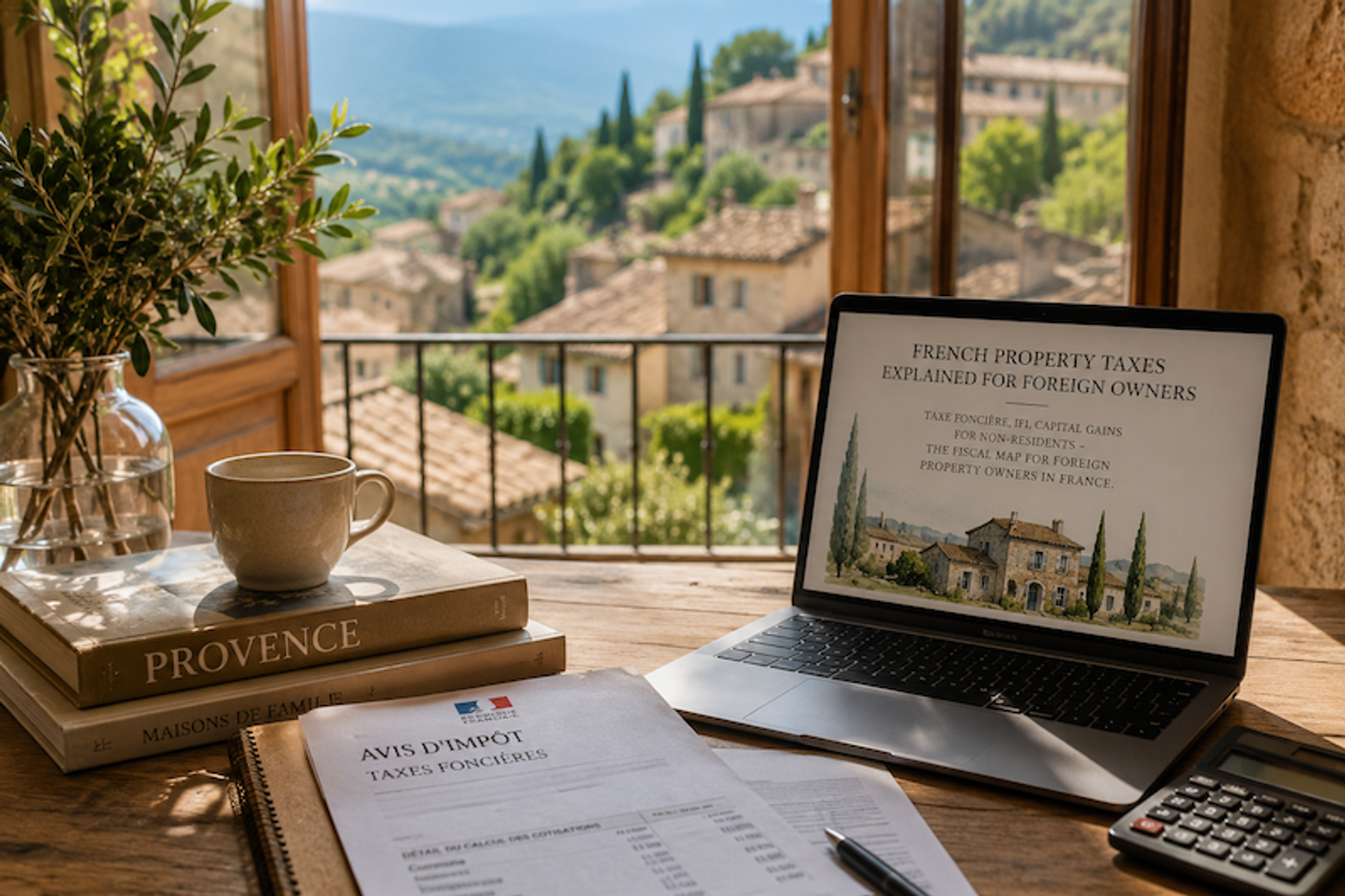
Every French property owner pays the taxe foncière, the annual property tax. It is calculated by the local commune (municipality) based on a notional rental value of your property, called the valeur locative cadastrale. The bill arrives in the autumn and is payable by mid-October.
How much? It varies enormously by location. A central Paris apartment of 70 m² might generate a taxe foncière of around 800 to 1,500 € per year. The same surface in Nice or Lyon often lands between 700 and 1,200 €. In smaller towns or rural Provence, you can sometimes pay less than 500 €. In a few communes that have raised their rates aggressively in recent years, including Paris itself after its 2023 hike, bills have climbed sharply, and this is worth checking before you buy.
The taxe d'habitation used to be paid by whoever occupied the property on January 1st, owner or tenant. It has now been abolished on primary residences but still applies to second homes, which catches a lot of international owners by surprise. In tourist-heavy communes, local councils are also allowed to add a majoration (surcharge) of up to 60 percent on second-home taxe d'habitation. Paris, Nice, Cannes, Saint-Tropez, Biarritz, and dozens of smaller communes have applied the maximum. For a second home in central Paris, this can easily mean an extra 1,500 to 3,000 € per year on top of the taxe foncière.
Wealth tax on real estate: the IFI
France's wealth tax, the impôt sur la fortune immobilière or IFI, applies specifically to real estate assets. It kicks in when the net value of your French real estate exceeds 1.3 million €.
For non-residents, this is the part that often surprises: the IFI applies only to property located in France, not to your worldwide real estate. So an American or Singaporean owner with a 2 million € apartment in the 7th arrondissement of Paris would owe IFI on that asset, regardless of what they own elsewhere.
Rates are progressive, starting at 0.5 percent and climbing to 1.5 percent on the slice above 10 million €. There is a small décote (rebate) just above the 1.3 million € threshold, and outstanding mortgage debt secured against the property is deductible, which materially reduces the bill for leveraged buyers.
A practical point: the IFI is not just for the ultra-wealthy. A couple buying a 1.6 million € family home in central Paris, Saint-Germain-en-Laye, or Cap Ferrat is in IFI territory from day one. Build it into your annual budget.
Income tax on rental income
If you rent out your French property, you pay French income tax on the rental income, full stop. Tax treaty or not, France taxes income from French real estate first.
The structure depends on whether you rent unfurnished or furnished. Unfurnished rentals fall under the revenus fonciers regime. Furnished rentals fall under the loueur en meublé non professionnel regime, known as LMNP, which allows you to deduct depreciation and is often significantly more tax-efficient.
For non-residents, the minimum effective rate is 20 percent up to a threshold, then 30 percent above it, plus social charges at 17.2 percent (reduced to 7.5 percent for EU and EEA residents covered by another country's social security). This 17.2 percent layer is a real cost and one of the most common surprises for new foreign owners.
Choosing the right rental regime, and the right structure, is one of the highest-leverage decisions in your French ownership. It deserves a proper conversation with a French expert-comptable (chartered accountant) before you sign anything.
Capital gains when you sell
When you sell French property, you pay French capital gains tax, the plus-value immobilière. The headline rate is 19 percent, plus the same 17.2 percent social charges, for a total of 36.2 percent on the taxable gain.
The good news: France has a generous holding-period taper. The income tax portion phases out fully after 22 years of ownership, and the social charges phase out fully after 30 years. Sell a property you have owned for 25 years, and the income tax slice is gone. For very high gains above 50,000 €, an additional surtax of up to 6 percent applies.
Your primary residence is fully exempt. For non-residents, there are specific exemptions and rules, including a partial exemption for former French tax residents selling within a defined window after leaving the country, capped at 150,000 € of gain. The rules are detailed, and timing your sale matters more than people realize.
For non-EU sellers, France requires a représentant fiscal accrédité (accredited tax representative) for transactions above 150,000 €, who handles the filing and is paid a fee, typically 0.4 to 1 percent of the sale price. Build this into your selling costs.
A final word
French property taxes are manageable once they are mapped out. The traps are not in the rates themselves, but in the details: the second-home surcharge, the IFI threshold, the social charges on rental income, the choice between furnished and unfurnished, the holding-period clock on capital gains. Get the structure right at the start, and the rest follows.
At Guava Partners, we work as the buyer-and-tenant advisor for our international clients across France, and we make sure the fiscal picture is on the table from the first meeting, not discovered after the deed is signed. We work alongside trusted French tax advisors and notaires who specialize in international cases. If you own French property or are planning to, and want a partner who understands both sides of the conversation, we would be glad to talk. You can find us at www.guava-partners.com.