There is a particular feeling that comes with deciding to buy a home in France. Maybe it started on a holiday in Provence, or during a work assignment in Paris, or simply as a long-held dream of a stone house with shutters and a garden. Whatever brought you here, you have probably also discovered that the French property system works very differently from what you know back home. The good news: it is a remarkably well-protected process for buyers. The challenge: it comes with its own vocabulary, its own timeline, and its own set of professionals you will need to understand. This guide walks you through the whole journey, from first viewing to final signature, so you know what is coming and why.
Good news first: France welcomes foreign buyers
Let's clear up the most common worry straight away. There is no restriction on foreigners buying property in France. Whether you are an EU citizen or not, whether you live in France or on the other side of the world, you have the same right to purchase as a French national. There is no special permit, no nationality requirement, and no extra layer of approval. Owning property does not grant you a visa or residency rights, and that is a separate matter to plan for if you intend to live in France full time. But the purchase itself is open to you on equal terms.
The professionals you will meet
French property transactions involve a few key players, and their roles are not always what you would expect. The notaire (notary) is the central figure. This is a public official, not a salesperson, and the notaire's job is to guarantee that the sale is legal, that the title is clean, and that taxes are properly collected. The notaire is impartial. Interestingly, a single notaire can handle the transaction for both buyer and seller, though as a buyer you are entitled to appoint your own at no extra cost, since the fee is fixed and shared. The agent immobilier (estate agent) markets properties and arranges viewings. Unlike in some countries, French agents almost always work for the seller, even though buyers often assume otherwise. This is precisely the gap that a buyer's agent fills. A buyer's agent, sometimes called a chasseur immobilier (property hunter), represents you and only you. They search on your behalf, assess whether a price is fair, handle negotiations, and guide you through the technical and legal steps. For an international buyer navigating an unfamiliar market in a second language, this kind of dedicated representation can be the difference between a stressful experience and a confident one.
Step one: defining your search and your budget
Before viewing anything, get clear on two numbers: your total budget and your purchasing costs. In France, the costs on top of the purchase price are commonly called frais de notaire (notary fees), though the term is slightly misleading. Most of that money is actually transfer tax going to the government, not the notaire's own fee. For an existing property (older than five years), budget roughly seven to eight percent of the purchase price. For new-build property, the figure is lower, around two to three percent. So a property listed at 300,000 euros will typically cost you closer to 322,000 euros once these fees are included. Knowing this from the start prevents an unpleasant surprise later.
Step two: financing your purchase
If you are paying in cash, you can move quickly. If you need a mortgage, the French banking system is conservative but stable, and non-residents can absolutely obtain French mortgages. A few things to know. French lenders focus heavily on your taux d'endettement (debt-to-income ratio), which is generally capped at around 35 percent of your gross income, including the new loan. Rates are often fixed for the entire life of the loan, which gives you long-term predictability. Non-residents are usually asked for a larger deposit, often 20 to 30 percent of the price. It is wise to get a sense of your borrowing capacity before you make offers, as French sellers take a financed offer more seriously when they can see it is realistic.
Step three: the offer
Once you find the property, you make an offre d'achat (offer to purchase). This can be written, and once a seller accepts a written offer at the asking price, the process is considered underway. France does not generally have the open-ended bidding culture found in some markets, though negotiation is normal and expected, particularly outside the most competitive areas.
Step four: the preliminary contract
This is the stage that surprises many foreign buyers, because the binding commitment comes early. Shortly after the offer is accepted, both parties sign a preliminary contract, usually a compromis de vente (preliminary sales agreement). This document is far more than a handshake. It sets the price, describes the property, lists the conditions, and commits both parties to completing the sale. At this point you normally pay a deposit of around 5 to 10 percent, held securely by the notaire. Two protections matter here. First, as the buyer you have a délai de rétractation (cooling-off period) of ten days after signing, during which you can withdraw for any reason at all and recover your deposit in full. Second, the contract includes conditions suspensives (conditional clauses) — most importantly, a mortgage clause. If your loan is genuinely refused, the sale is cancelled and your deposit is returned. Make sure these clauses are properly drafted; this is exactly where good representation earns its keep.
Step five: the notaire's investigation
Between the preliminary contract and the final signature, the notaire carries out the legal groundwork. This typically takes two to three months. During this period the notaire verifies the title, checks for mortgages or charges against the property, confirms there are no pre-emption rights (a local authority's right to buy first), and assembles the diagnostics — a mandatory set of technical surveys covering energy performance, lead, asbestos, termites, electrical and gas safety, and risk exposure. As a buyer, read these carefully. The DPE (energy performance diagnostic) in particular has real financial consequences, since poorly rated properties face growing restrictions and renovation costs.
Step six: the final signature
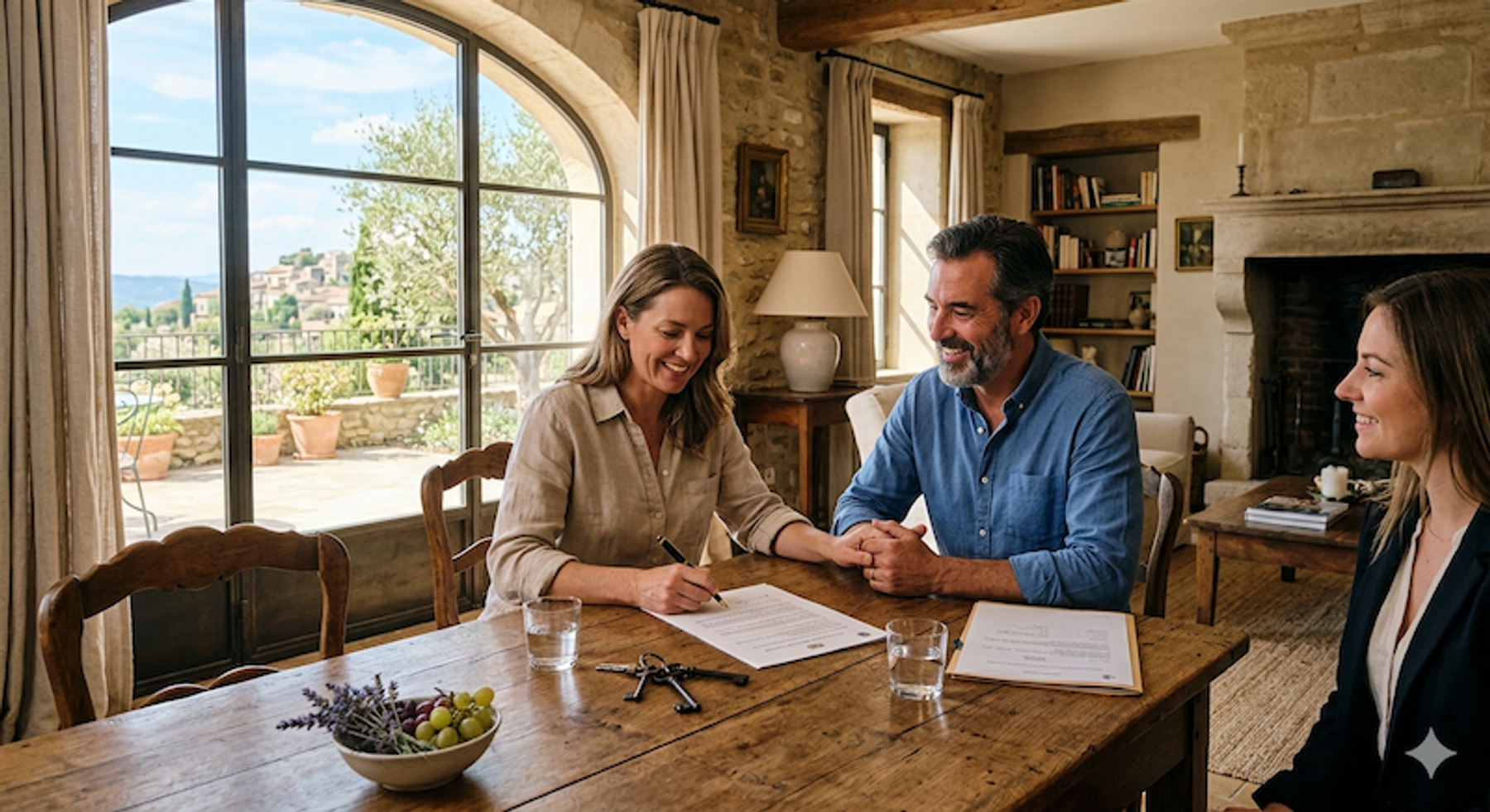
The transaction concludes with the acte de vente (deed of sale), also called the acte authentique, signed at the notaire's office. On this day, the balance of the funds is transferred, the notaire reads and registers the deed, and you receive the keys. You become the legal owner immediately. If you cannot attend in person, you can sign through a procuration (power of attorney), which is common and entirely standard for international buyers.
A quick word on taxes after purchase
Owning property in France comes with two annual local taxes to be aware of: the taxe foncière (property owners' tax), paid by the owner, and the taxe d'habitation (residence tax), which still applies to second homes. Rates vary widely by commune. If the property is not your main residence, there may also be wealth tax and rental income considerations depending on your situation, and these are worth discussing with a French tax adviser early.
The shape of the whole journey
From accepted offer to keys in hand, a typical purchase takes around three months. The system front-loads your commitment but protects you heavily in return: the cooling-off period, the conditional clauses, and the impartial notaire all exist to keep buyers safe. What it does not do automatically is give you someone in your corner. The notaire is neutral, and the estate agent works for the seller. Having an advisor who represents you alone, explains each document in your own language, and knows when a price or a clause deserves a second look turns an intimidating process into a clear one. At Guava, that is the whole reason we exist. Stéphanie experienced the French property market firsthand as an expat arriving from Los Angeles, and we built our firm to be the buyer-side partner we wished we had had. If you are thinking about buying in France and would like someone genuinely on your side, we would love to talk.